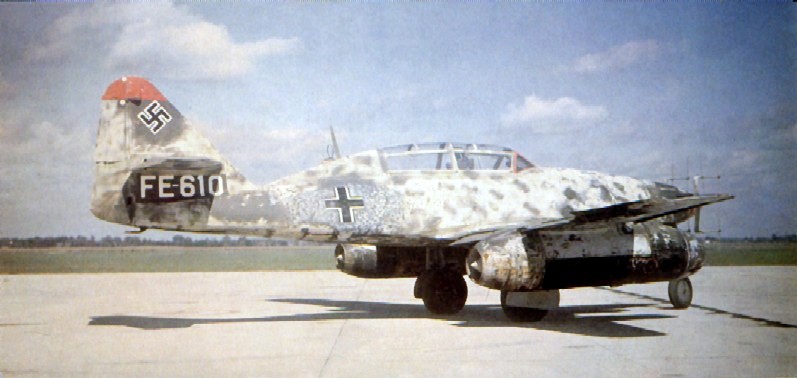
Si consideri il primo jet a reazione da combattimento... e immaginate di volare! Ecco la relazione sul Me-262 (cliccate sul titolo del
per scaricarla) con tanto di allegato in MATLAB.
. Per la Meccanica del Volo sono necessarie un minimo di Matematica (Analisi 1, ma neanche), un po' di Fisica (Meccanica del punto materiale) ed elementi di
. Per il MATLAB... un po' di informatica e conoscenza del linguaggio MATLAB.
Bibliografia (per la Meccanica del Volo):
Anderson, John D. Jr. - Introduction to Flight - McGraw-Hill International EditionISBN 007-123818-2
%%%%%%%%%%%%%%%%%%%%%%%%%%
%% Messerschmitt Me-262 %%
%%%%%%%%%%%%%%%%%%%%%%%%%%
clear all
clc
format short g
% Aircraft data
b = 12.50 % wingspan (m)
S = 21.70 % wing area (m^2)
hw = 1.5 % wing height from ground (m)
Wg = 6400*9.8 % gross weight (N)
W = 5000*9.8 % average weight (N)
We = 3800*9.8 % empty weight (N)
cL_max = 2.0 % max lift coefficient
cDo = 0.020 % zero-lift drag coefficient
e = 0.7 % Oswald efficiency factor
AR = b^2/S % aspect ratio
Ta_max = 2*900*9.8 % max trhust available (N)
%% Mission briefing:
%% 1) Takeoff
%% 2) Climb at 6,000 meters
%% 3) Cruise
%% 4) Gliding
%% 5) Landing
%% 1) Calculation of the takeoff distance on runway
rho = 1.225 % air density at sea level
g = 9.8 % gravity acceleration
mr = 0.02 % runway friction coefficient
Vmin = sqrt(2*Wg/(rho*S*cL_max)) % stall speed
Vto = 1.2 * Vmin % takeoff speed
phi = (16*hw/b)^2/(1+(16*hw/b)^2) % coefficient due to ground effect
D = 0.5*rho*(0.7*Vto)^2*S*(cDo+phi*cL_max^2/(pi*AR*e)) % average drag
L = 0.5*rho*(0.7*Vto)^2*S*cL_max % average lift
dto = 1.44*Wg^2/(rho*S*cL_max*g*(Ta_max-D-mr*(Wg-L))) % takeoff distance
%% 2) Calculation of the max rate of climb
h = 6000 % cruise altitude
rho_h = 0.66011 % air density at 6000 meters
for i = 1:300
V(i) = i;
q(i) = rho*V(i)^2/2; % dynamic pressure
cL(i) = Wg/(q(i)*S) ; % lift coefficient
cD(i) = cDo + cL(i)^2/(pi*e*AR); % drag coefficient
Pr_zl(i) = q(i)*S*V(i)*cDo; % power due to zero-lift drag
Pr_id(i) = q(i)*S*V(i)*cL(i)^2/(pi*AR*e); % power due to induced drag
Pr(i) = Pr_zl(i) + Pr_id(i); % power required at sea level
Pa(i) = Ta_max * V(i); % MAX power available at sea level
EoP(i) = (Pa(i) - Pr(i)); % excess of power
RC(i) = (EoP(i))/Wg; % R/C = excess of power / weight
RC_mpm(i) = RC(i) * 60; % meters per minute
RC_mpm_h(i) = RC_mpm(i) * rho_h/rho; % rate of climb at 6000 meters
end
RCmax = max(EoP)/Wg % max rate of climb at sea level
RCmax_mpm = RCmax * 60
RCmax_h = RCmax * rho_h/rho % max rate of climb at 6000 meters
RCmax_h_mpm = RCmax_h * 60
plot (V,Pa, 'r.')
hold on
plot (V,Pr_zl, 'g.')
hold on
plot (V,Pr_id, 'b.')
hold on
plot (V,Pr, 'k.')
grid on
title ('Me-262 - Power required and power available at sea level')
xlabel ('Velocity (m/s)')
ylabel ('Power (W)')
axis ([0 300 0 5e6])
legend ('MAX power available', 'power due to zero-lift drag',...
'power due to induced drag', 'power required')
figure
plot (V,RC_mpm, 'g.')
hold on
plot (V,RC_mpm_h, 'b.')
grid on
title ('Me-262 - Rate of Climb')
xlabel ('Velocity (m/s)')
ylabel ('Rate of Climb (m/min)')
axis ([0 300 0 2000])
legend ('sea level', '6000 meters')
av_RC = (RCmax + RCmax_h)/2 % average rate to climb
av_RC_mpm = av_RC * 60
time = h/av_RC % approx. time to climb
%% 3) Cruise flight
Ta = 0.8 * Ta_max * rho_h/rho % cruise thrust available at 6000 meters
for i = 1:300
V(i) = (i+34)*sqrt(rho/rho_h);
q(i) = rho_h*V(i)^2/2;
Tr_zl(i) = q(i)*S*cDo; % thrust due to zero-lift drag
Tr_id(i) = W^2/(q(i)*S*pi*e*AR); % thrust due to induced drag
Tr(i) = Tr_zl(i) + Tr_id(i); % thrust required
cL(i) = W/(q(i)*S);
cD(i) = cDo + cL(i)^2/(pi*e*AR);
E(i) = cL(i)/cD(i); % aerodynamic efficiency
end
figure
plot (V,Tr_zl, '.g')
hold on
plot (V,Tr_id, '.r')
hold on
plot (V,Tr, '.k')
hold on
plot (V,Ta, '.b')
grid on
axis ([0 300 0 1.5e4])
title ('Me-262 - Thrust required curves at 6000 meters')
xlabel ('Velocity (m/s)')
ylabel ('Thrust (N)')
legend ('thrust due to zero-lift drag','thrust due to induced drag',...
'thrust required', 'thrust available')
figure
plot (V,E, '.')
grid on
axis ([0 300 0 20])
title ('Me-262 - Aerodynamic efficiency')
xlabel (' Velocity (m/s)')
ylabel ('E = cL/cD')
Tmin = min(Tr) % min thrust
Emax = max(E) % max aerodynamic efficiency
VTmin = sqrt(Tmin/(rho_h*S*cDo)) % min thrust (max efficiency) airspeed
VTmin_KPH = VTmin * 3.6
%% 4) Calculation of the max range in gliding flight
theta = atand(1/Emax) % glide angle at max efficiency
range = h * Emax % max range in gliding at 6000 meters
%% 5) Calculation of the landing distance on the grass
Vmin = sqrt(2*We/(rho*S*cL_max)) % stall speed
Vl = 1.3 * Vmin % landing speed
mg = 0.60 % grass + brake friction coefficient
D = 0.5*rho*(0.7*Vl)^2*S*(cDo+phi*cL_max^2/(pi*e*AR)) % average drag
L = 0.5*rho*(0.7*Vl)^2*S*cL_max % average lift
dl = 1.69*We^2/(g*rho*S*cL_max*(D+mg*(W-L))) % landing distance




 Post
Post


